If you like, please share.
Basic Income India
  • About
  • Blog Posts
  • Contact
  • The Great Indian debate on Cash Transfers and Basic Income
  • Ghodakhurd Diary
  • The Book
  • India Pilot Study Report
  • Films on Basic Income
  • Around the World
  • Ideas for Posters

Two More Community Initiatives of Basic Income

6/3/2016

1 Comment

 
Picture
​

​Inspired by what Michael Bohmeyer did in Germany, two more crowd-funded community initiatives have come up. One in The Netherlands and one in the US (San Francisco). Here is a summary by Scott Santens. What is really interesting about the author is that he had crowd-funded his own basic income over a period of two years to write about Basic Income!!!

​Isn’t that awesome?

Scott Santens is a writer and basic income advocate; moderator of the /r/BasicIncome community on Reddit, and founder of "The BIG Patreon Creator Pledge."

http://www.scottsantens.com/raffling-basic-income-first-germany-then-the-netherlands-and-now-the-us


​

1 Comment

Universal Basic Income as a step towards Securing Inherent Human Dignity

27/2/2016

8 Comments

 
Guest post by Rejitha Nair

Picture


​Human dignity
 is a value that is at the very foundation of our civilization, and our existence as a community. Unconditional and Universal Basic Income can be the gateway to a more humane society that takes human dignity very seriously, and grants a dignified life to all its citizens. In this guest post, Rejitha is examining the relationship between UBI and Human Dignity, and argues that we need to radically transform the way think about social security, if we have to achieve a dignified life for all the citizens. .  

Rejitha is a faculty member at the Institute of Law, Nirma University, Ahmedabad. She has a keen interest in Human Rights Law and the interplay between law and poverty. She is also a PhD candidate at the National Academy of Legal Studies and Research (NALSAR) Hyderabad. In her thesis, she is examining the relationship between universal basic income and human dignity, and exploring UBI as an alternative way of thinking about social security in India. 


The belief in inherent dignity of human beings is undoubtedly the central point of modern human rights discourse. The idea of human beings as agents capable of making moral choices, resisting injustices and participating in shaping of society is the fundamental premise of all human rights movements; all our socio- political relations are informed by this value. The world community has unequivocally recognised the inherent dignity of all members of the human family as the foundation of freedom, justice and peace in the world.[1] Political rights and economic, social and cultural rights that we all endorse unflinchingly are derived from this very value.

The biggest impediments to securing human dignity are poverty and destitution. In India, under the poverty alleviation schemes we invest most of our resources in designing and implementing means tests to identify the target groups, and then devising strategies to provide them basic necessities like food and income. There is much legislation for providing the poor with basic necessities or for ensuring their livelihood, but the implementation of these statutes and schemes is very poor, to say the least.

The problem is at the very root of how we perceive poverty. As long as we continue to see poverty as a mere material lack of food, clothing, shelter, and livelihood, we continue to make schemes filling those material gaps. On the other hand, poverty needs to be seen from the lens of “capabilities deprivation” or denial of opportunity to develop. The covenants mentioned above declare that respect for human dignity requires the society to ensure a minimum threshold of capabilities for truly human functioning, and social structures and direct state actions ought to be evaluated on this basis. This alternative framework departs from describing impoverishment and destitution  purely on material terms. It takes into account the everyday indignities a person has to go through which include pain, discomfort, exhaustion, discrimination, exclusion, voicelessness, stigmatisation, vulnerability, fear, low self-esteem, humiliation, shame, etc.

Only a strong redistributive policy can respond to these indignities, and ensure every citizen a minimum threshold of capability for a truly human functioning. Flowing from such a manner of thinking is the idea of unconditional and Universal Basic Income (UBI).  Under the concept of universal basic income all citizens are given a monthly income sufficiently high to meet the basic necessities of life, but not as high as to act as a disincentive to work. This monthly income is universal rather than means-tested; it is given automatically to all citizens regardless of their individual economic circumstances. And it is unconditional, i.e., in order to receive basic income one need not perform any labour or satisfy any other conditions, or promise and conform to any specific outcomes. The features of UBI has great implications for securing dignity of human life.  

​UBI is not only easy to administer, but also challenges the stigmatizing notion of certain human beings as ‘dependent’ and the moral blameworthiness of group experiencing poverty. People would not have to live in constant fear and anxiety of exclusion because of failing to meet eligibility criteria to avail benefits. In fact it would be a step towards substantively egalitarian society, ensuring the Right to a Decent Standard of Living[2] for all human beings irrespective of their economic status or their contribution to the labour market.

In a world where people are excluded from development opportunities because of their gender, ethnicity, age, sexual orientation, disability or poverty, and where distribution of income is becoming increasingly unequal; there is a need for a radical and fundamental shift in the way we look at social security. It need not be ‘targeted’ only at the ‘disadvantaged groups’ but should be a right available to everyone; as “something on which a person can safely count, a material foundation on which a life can firmly rest.”[3]

When subsistence is ensured and people are not under constant threat of starvation and malnourishment; they are undoubtedly in a better position to assume their role as citizens, parents, workers and social beings. Basic income protects people’s autonomy and freedom to make decisions freely about matters concerning them, and not act out of compulsion and helplessness. There is also evidence of basic income having positively impacted access to productive and income-generating resources such as credit, land, common property resources, etc. With a basic income people are found to be more likely to take livelihood and economic risks and are capable of acting autonomous agents to pursue their good in life. Further, since basic income is not provided because of a person’s situation of disadvantage but it is ensured to everyone just by virtue of being a member of humankind; it in a large way abrogates the stigma attached to ‘beneficiaries’ as societal burden or failed citizens. It brings about everyone to an equal platform, materially and politically, where, as emancipated citizens, they contribute to the shaping of social, political and economic goals.

---------------------------------------

[1] Preamble, Universal Declaration of Human Rights 1948.

[2] Right to decent standard of living has been recognised as an inherent inalienable right of Individuals under Art 25 of Universal Declaration of Human Rights, 1948; Article 11 of International Covenant on Economic Social and Cultural Rights, 1976.

[3] Van Parijs, P.2001. A basic income for all. In: Cohen, J and Rogers. ed.What’s wrong with a free lunch. Beacon Press Books, p.5. 
8 Comments

'My Basic Income' : A Fascinating Community Initiative and a Social Experiment in Germany 

11/2/2016

0 Comments

 
Picture

Whenever we think of a basic income or anything to do with social security, our knee-jerk reaction is that the state should provide it. We rarely think of community taking up such an initiative. It is of course true that in many societies in Asia, particularly India, the extended family had always acted as the social security net. With the breakdown of the joint family, rapid urbanisation and dispersal of the traditional family institution,  this traditional social security framework is getting eroded. However, new forms of community spirit seems to be emerging now. Can a community initiate something as BIG as basic income?

Seems so. 

A 30-year old young man called Michael Bohmeyer from Berlin founded a crowd-funded community initiative called 'My Basic Income' in 2014. Michael Bohmeyer has been a web developer and founder of several online start-ups since the age of 16. After working for fourteen years, he finally escaped the world of business, provided with a monthly basic income which is paid for by one of the start-ups that he founded. Michael now campaigns to get a basic income for as many people as possible.

He says:

“Because a basic income means freedom and unconditional humanity. And both are essential ingredients for a better society.”

The initiative was founded in 2014, and two years on, it is growing stronger and has gained many supporters. 

Read on... 

​"A German crowdfunding project has been collecting money so that every month a lucky winner gets a basic monthly income for a year. It's a campaign and a social experiment - and it's re-started an old debate in Germany.

What would you do with 1,000 euros ($1,120) of free money every month? Or, more exactly, what would you do if the government gave you an income - enough to ensure a comfortable life, but few luxuries - but you got it unconditionally, regardless of your actual needs, your other income, even your age? Would you ever work again? And, more to the point, would society collapse if everyone in the country got it?


These are the questions that German crowdfunding campaign Mein Grundeinkommen ("My basic income") has been trying to answer".


Read the full report on the DW website.  

http://www.dw.com/en/free-money-germanys-basic-income-lottery/a-18764779


​
​
​
   
0 Comments

A Citizen's Dividend from Mining  

11/2/2016

3 Comments


​Guest post by Rahul Basu

​The Goa Foundation, an environmental NGO based in Goa, India is proposing a set of reforms to mining, based largely on the work of the World Bank, IMF and a number of the people conducting the course. Our lens to view mining is the perspective of the owner of the minerals. One of our key recommendations is a Citizen's Dividend, the most successful variant of Universal Basic Income.

We argue:


  • When we inherit something, we are simply its custodians. We are obliged to preserve the value of our inheritance and pass it on to our children. This is also the Inter-generational Equity principle.
  • Minerals are non-renewable inherited assets.  Under the Indian Constitution, the state government owns minerals, not the federal government. Therefore, in India, this obligation to preserve the value devolves on the government of the state of Goa.
  • Imagine we own a piece of gold. We must prevent its theft. We can contemplate selling it to buy agricultural land that will provide income while the preserving value of the gold. By analogy, the mineral remains intact for our children only when we prevent illegal mining. If we decide to sell our minerals, through mining, we must create new non-wasting assets of at least equal value. 

We found:

At the root is our analysis on iron ore mining in Goa. We found that as far as iron ore mining was concerned, we were losing 95% of the value (economic rent) of our minerals, Rs. 51,446 crores (~US$ 8.5 billion). This was over an eight year period. The loss amounted to 28% of the Goa GDP for those years, twice the state revenues for those years, and Rs.3.5 lakhs each (~$5,800). Our analysis was based on the annual reports of Sesa Goa (now Vedanta India), the largest iron ore mining company in Goa.

Note that since minerals are a part of the commons, i.e., owned by all of us, this loss is effectively per-head tax - everyone loses equally, and a few get richer. This is a highly regressive redistribution of wealth. It is contrary to equality, and contrary to Article 17 of the UN Declaration of Human Rights. 

We have found similar issues in fossil fuels in India. As royalty rates are usually set by trying to attract investment into the sector, countries race to the bottom. Therefore, it is very likely that similar losses are present globally. It is possibly even a significant driver of the growing inequality that Piketty has found.

We want:

1. Zero loss mining - the owners on behalf of our children and future generations (the State of Goa in particular), must ensure that the full value of the mineral be captured. Losses are unacceptable.

2. All receipts from minerals be treated as capital receipts (sale of assets) and be deposited into a Future Generations Fund, invested entirely overseas. This is like the Norway Government Pension Fund. Currently, mineral receipts such royalties are treated as windfall revenues, to be blown up. Instead, they are our inheritance, and must be saved for our children. A Future Generations Fund is simply an endowment fund whose income is reinvested to fully compensate for inflation. 

3. All the real income from the fund be distributed equally to all as a Citizen's Dividend, as a right of ownership. This is like the the Alaska Permanent Fund Dividend. The principal goal is to create a stake for the Citizen in their minerals. All must be distributed to leave the state as a non-mineral state - no incomes from minerals.
4. We want this implemented across India and globally. It is fair, our right and our duty to our children.

To read more on this campaign and follow it please visit:

 www.facebook.com/goenchimati  or  www.twitter.com/goenchimati  or  www.goenchimati.org.
or write to Rahul at [email protected]
3 Comments

Call for Papers and Proposals - BIEN Congress 2016, Seoul, South Korea

9/2/2016

0 Comments


BIEN is Basic Income Earth Network. It holds an international Congress every two years. The last Congress was held in 2014 in Montreal. This year BIEN is going to have its 16th BIEN Congress in Seoul, South Korea from 7th to 9th of July 2016. The Congress theme is :

"Social and Ecological Transformation and Basic Income"

It is a fantastic opportunity to learn about Basic Income and meet people from all over the world who are working on it. If you are interested in presenting a paper, please follow the following links:

http://www.basicincome.org/news/2016/01/bien-conference-deadline-for-proposals-this-sunday-january-31-2016/

http://bien2016.org/en/call-for-papers-and-proposals/?ckattempt=1

​The deadline has been extended to February 29,2016.
​ 
If you need any help in deciding, please do write to me or call me. As you all know, BIEN is an NGO and works mostly with help of volunteers, 'BIENefactors' and some sympathetic donors. You need to organise your own funding to attend the Congress. 
  
0 Comments

Notes on Basic Income and Capital-ism 

14/7/2015

0 Comments

 
This is a guest post by V. Janardhan

(Dr. V. Janardhan is a sociologist at the Department of Sociology, University of Hyderabad, India. He has worked and written on trade unions, industrial relations, and is presently fascinated with ethics, political sociology, and philosophy. [email protected])


‘Basic income’ has had a relation with capital-ism historically which would come as a surprise to many. Of course, it was not termed as ‘basic income’ until recently but the notion and purpose have been the same.  While terminology underwent a change in one, the system itself kept changing in the case of the other. Except for extreme tendencies of opinion, the mainstream for one would concede that capital-ism has played a historic role; even Marx would so concede. Thus the system has stood the test of time, has been the main driver of the modernity project and  will continue for an indefinite period. This is so notwithstanding the doomsday prophets, the latest being the environmental totalitarians. But this does not mean that one is being oblivious to ecology and its concerns. Indeed it will be organized capitalism that will adequately address the ecological question ultimately.  

At all times historically, enlightened capitalists and their managerial cadres concerned themselves with ‘basic income’. Arguably, they made life easier, the world a better place to live in, and capital-ism sustainable thereby. The triumph of capital-ism, among other things, has been due to its ingenuity and its capacity to reinvent itself. While its detractors always saw in every crisis of capitalism the imminent demise of the system, capital and its agents saw in every crisis a challenge to engage and overcome.

Henry Ford was one of the foremost of entrepreneurs to discern the crucial connection between production and consumption. He realized that the same workforce that made commodities inside the factory consumed them outside. The product therefore had to be within the reach of an average worker-consumer. That could only happen if the worker had a guaranteed wage at all times. He would then not only afford buying the product, the latter’s stock would also move out of the warehouses making fresh rounds of production feasible. Thus came into being the ‘Five-Dollar Day’. Fordism, as the system came to be known, had as one of its main pillars the institutionalization of a ‘basic income’ which workers took home every day.

Income generation was an important aspect of Keynesianism.  It was a method to bail out capital-ism.  The state made heavy investments in the economy thereby generating employment … and incomes! By restoring purchasing power and empowering the consumer, the state restored dynamism to the system. Not only did capitalism get a reprieve, the citizenry too was spared much misery. The theme-song of capital seems to be a’la Raj Kapoor’s melody: Tumhaare bhi Jai Jai/ Hamare bhi jai jai/ Naa tum haare, naa hum haare. There is agony in capitalism. There is also ecstasy.

Now the time has come when the state can directly empower those citizens who otherwise do not figure in ‘effective demand’ because of lack of purchasing power. The direct empowerment would be through the disbursal of a ‘basic income’. In any case this would become inevitable in industrial and post-industrial societies as increasingly jobs get eliminated and more and more workforces get redundant. While the apocalyptic would dream of radical visions, the practical would get to work and see how suffering can be mitigated. ‘Basic income’ shows the way out.

‘Basic income’ can outlive even the capital-ism as we know it today. It is thus a stand-alone and an absolute concept/idea. Presently as global capital-ism creates a world subject to constant economic change, the idea and practice of basic income can ensure stability. One is today interested in a win-win situation where an out-of-work worker can still exist as a human being rather than in the ‘collapse’ of the existing and the bringing in of a fantasy. Ultimately, basic income is a sine qua non in any social system, and its provision an important imperative of capital and the state singly and jointly.
0 Comments

Is Basic Income relevant in the Indian context?

10/7/2015

0 Comments

 
Picture

Sarath Davala


To address this question, we need to examine the Indian social protection system as it exists today, and see what the issues and problems are. In the first place, compared to several of the Asian countries, India spends much less on social protection.  It spends about 1.7 percent of its GDP. Compare this with 5.4 % by China and nearly 9 % by South Korea and 19.4% by Japan!  

However, in relative terms, in the last 15 years, due to high rate of growth, the net amount allocated and spent by the Indian government on welfare has increased several fold.  On what does Indian government spend its welfare money?

The two main flagship programs that swallow bulk of India’s social spending are:

1. Targeted Public Distribution System (PDS): PDS is a system of transferring food grains such as rice, wheat, sugar, etc., items to eligible poor families. The total food subsidy that the Indian budget for 2015-16 has earmarked is Rs. 1,24 trillion rupees. Which is nearly 20 billion US dollars. The allocation for the consumer alone, i.e., to implement the National Food Security Act is Rs. 650 billion ($ 10.24 billion). 

2. National Rural Employment Guarantee Act (NREGA) – This is an Act of Parliament that provides, as a matter of right, 100 days of guaranteed employment to each rural household. The budget allocation for the financial year 2014-15 was Rs. 396 billion which is about $ 6.24 billion.

Then come the other programs such as mid-day meals in schools, old age and disabled pensions, scholarship, etc. These are well-meaning programs, but the biggest problem with them is that the benefit does not reach the intended population effectively and efficiently. Let us take the example of the PDS which is the single largest chunk of money in India’s social spending.

There are three types of issues that plague the PDS system.

1. Design Problems: The fact that the Government of India (GOI) has undertaken to procure, store and distribute food grains through Food Corporation of India (FCI) across the country is seriously flawed. The Shanta Kumar High level Committee appointed by GOI which submitted its report (January 2015) on restructuring FCI estimates that nearly 47 percent of the food grains from the PDS system leak or get diverted to the black market.[1]. Economists who support the PDS system dispute this figure and, ironically, reduce the leakage to 42 percent[2]. Secondly and equally importantly, the administrative cost of delivering the food grain is also unacceptably high. According to a Planning Commission study (2005), India spends about Rs. 3.65 to deliver one rupee of welfare to the poor.[3] There perhaps cannot be a more dismal picture than this.    

2. Definitional Problems: By design, all Indian welfare assistance schemes are conditional. The question is who the government thinks deserves welfare assistance. The GOI from time to time defines what is called  the ‘poverty line’. According to Rangarajan Committee (2014) which is by far the latest definition, in the rural areas, a person is defined as poor if she is earning Rs. 32, i.e., roughly half a US dollar. By this definition, about one third of the Indian rural population is poor. This is ascertained though periodic surveys. The biggest problem is not defining the poverty line, but ascertaining who actually earns below this amount. The surveys undertaken by governments are riddled with problems, and a large population that ought to be receiving welfare is left out. And those that should not be receiving actually receive. The NC Saxena Committee on reexamining the methodology followed in poverty estimates severely criticizes the current methodologies employed[4].

3. Delivery problems: As the saying goes, ‘there’s many a slip between cup and the lip’. Quite apart from the fact that the administrative costs are ridiculously high, there are two additional problems at the delivery end. One, the discretion that lies with the agent who runs the ‘ration shop’ and how that is misused. He could give less quantity or he could also open the shop at a time most inconvenient to the workers. Either workers may  decide not to go to work and thus forgo their wages, or simply lose the subsidised food grains. Further, there could be a government order that recipients should pick up grains for three months or six months at once (in monsoon season due to logistic reasons). If the recipients do not have cash to pick up their quota, they stand to lose it. Second, the poor quality of the grains that are delivered severely undermine and erode the value of the subsidy, in terms of the time spent in cleaning it, and the loss of some part of the total quantity.

Having reviewed an example of the existing social protection system in India, two issues we need to ponder. 
1. Can we reduce our understanding of poverty just to food or lack of it? Is poverty just about not having enough food? 
2. By giving 35 kilograms of wheat or rice per family per month, which going by the above discussion one is not sure if it reaches the intended households, can we arrogate to ourselves that we are addressing poverty ? Is that all it takes to remove  poverty?

It is against this backdrop that we need to see the relevance of Basic Income in India.

-----------------------
[1]http://www.fci.gov.in/app/webroot/upload/News/Report%20of%20the%20High%20Level%20Committee%20on%20Reorienting%20the%20Role%20and%20Restructuring%20of%20FCI_English_1.pdf
[2] http://www.thehindu.com/news/national/economists-dispute-govt-claims-on-pds-leakage/article6853563.ece
[3] http://planningcommission.nic.in/reports/peoreport/peo/peo_tpds.pdf
[4] http://www.thehindu.com/opinion/lead/poverty-estimates-vs-food-entitlements/article112226.ece


Sarath Davala is an independent sociologist based in Hyderabad, India. He may be contacted at [email protected]
0 Comments

What is Direct Benefit Transfer? How is it different from Basic Income? 

9/7/2015

18 Comments

 
Picture

Sarath Davala


There are several terms that are in currency now in the Indian discussion. ‘Cash Transfers’, Direct Benefit Transfer’, ‘Basic Income’, and so on.  

Cash Transfers
Cash transfers simply means transfer of cash. However, in the development sector the meaning is a bit more loaded. It refers to welfare assistance usually provided by any government to a particular group of people or a section of the society. It also means transfer of cash as opposed to transfer of goods or services. For instance, instead of directly disbursing subsidised fuel or food grains, the government may decide to transfer equivalent value in cash so that the recipient may purchase the goods in the open market. In terms of effectiveness, there are arguments both in favour of and against cash transfers.
 
Direct Benefit Transfer
Direct Benefit Transfer (DBT) is an initiative taken by the Congress government in 2013 to make the transfer of welfare benefits to the recipients transparent and more efficient. The purpose of DBT as defined by Government of India (GOI) is as follows: 

“The purpose of Direct Benefit Transfer is to ensure that benefits go to individuals' bank accounts electronically, minimising tiers involved in fund flow thereby reducing delay in payment, ensuring accurate targeting of the beneficiary and curbing pilferage and duplication.[1]” 

DBT has been implemented in stages across the country for a variety of welfare schemes. However, it has seen major success in the case of the LPG (Liquid Petroleum Gas) subsidy which is the subsidised cooking gas for domestic use. Prior to introducing DBT scheme, government used to provide subsidy directly to the oil companies, and in turn they would sell cooking gas to consumers at the subsidised price. The scheme, introduced in 2013 by GOI, stipulated that the companies sell gas to consumers at market price, and the government will directly transfer the subsidy to the bank account of the consumer. By means of DBT, the government has been able to save nearly Rs. 12,000 crores, i.e., about 1.9 billion US dollars. This is quite a substantial savings for the government.

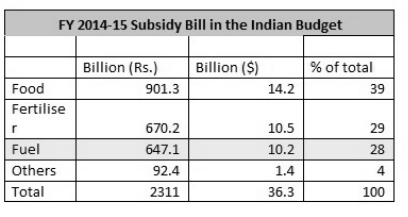
The following table shows the volume of Indian government’s subsidy bill for the financial year 2014-15. Government sees DBT as a method by which it can save billions of rupees without affecting the end-beneficiary, and perhaps even benefiting them by means of eliminating the pilferage and corruption.

Recently, at a roundtable on “Direct Benefit and Basic Income Transfers” organised by the International Centre for Human Development in New Delhi, the Chief Economic Advisor to Government of India, Mr. Arvind Subramanian said:  ‘By moving from a regime of subsidies to transfers, you liberate the market system to work more efficiently.’ According to him, the DBT scheme will allow the transfer of benefits in a leakage-proof, targeted and cashless mode. ‘It is above all a way of improving the life of the vulnerable and the poor.’[2]

DBT however requires a robust banking infrastructure and hundred percent financial inclusion. The LPG could succeed to such an extent primarily because bulk of the LPG consumers are urban-based.  

Basic Income
Basic Income however is different. The term comes more from a rights perspective. Those who advocate Basic Income contend that every individual in the society must be entitled to a basic income so that he / she can access the basic material requirements of life. This income should be given to all citizens without any work requirement or means test. In other words, by definition,  basic income should be given unconditionally. Other terms that are used which are similar to basic income are: Citizens’ Dividend, Guaranteed Minimum Income, Basic Income Guarantee, Unconditional Cash Transfer, and so on. More on these copncepts later.

The point is that Basic Income is indeed different from Direct Benefit Transfer. DBT is a solution concerning delivery alone. The system unclogs the pipes that deliver welfare benefits to the poor. The infrastructure that DBT provides is an excellent first step towards introducing Basic Income in future.     

----------------------------------------------------
[1]  http://www.dbtmis.planningcommission.nic.in/dbtentry/homepage.aspx
[2]http://www.financialexpress.com/article/economy/direct-benefit-transfer-a-game-changer-arvind-subramanian/93607/


Sarath Davala is an indpendent sociologist based in Hyderabad, India. He may be contacted at [email protected]
18 Comments

What is Basic Income?

8/7/2015

6 Comments


Sarath Davala


Basic Income is an income that is paid by the government unconditionally to all its citizens. It is paid monthly to every individual irrespective of their social and economic status, i.e., without any means test or work requirement. The basic principle behind is that every citizen is entitled to a basic income, as a matter of right, so as to meet her basic material requirements of life.

The key words in this definition are: unconditional, individual, monthly payment,  universal. In its pure form, Basic Income should have all the four elements. 

Why Unconditional?
Conditionalities, as they are generally called, usually  accompany any welfare giving by the state. That is, in order to receive welfare assistance, whether it is in terms of cash or kind (food grains or other goods), the recipient has to first of all prove that he / she is eligible, and thereafter provide evidence that the assistance given is being used for the purpose for which it is meant. These conditionalities give discretion to the muscle-end of the bureaucracy, which inevitably leads to corruption. This results in what are called ‘inclusion errors’ and ‘exclusion errors’.  The inclusion errors refers to a situation wherein those who should not be in the receiving group manage to enter it, and the exclusion errors refer to a situation where those who should be present in the receiving group are excluded. The idea of making basic income unconditional is primarily to overcome these errors. 

Why Individual?
Basic Income is an entitlement to an individual, be it a child or an adult. It grants economic citizenship to each and every individual in the country, and recognises that person as an active member of the economy - contributing to it, and therefore having a right to partake in the proceeds of the economy.

Why Monthly Payments?
Monthly payments are perhaps the real cutting edge of basic income. A monthly income provides the recipient a future orientation and a sense of security and purpose. Basic income necessarily has to be a monthly income.

Why Universal?
Basic Income should be universal because the entitlement comes to each individual in his / her capacity as a citizen. In principle, it is an affirmation of citizenship and a basis for solidarity.


Sarath Davala is an indpendent sociologist based in Hyderabad, India. He may be contacted at [email protected]
6 Comments

    Archives

    March 2016
    February 2016
    July 2015


    Other blog posts (scroll down)
    • Is Basic Income relevant in the Indian context?
    • What is Direct Benefit Transfer? How is it Different from Basic Income?
    • What is Basic Income?

Powered by Create your own unique website with customizable templates.